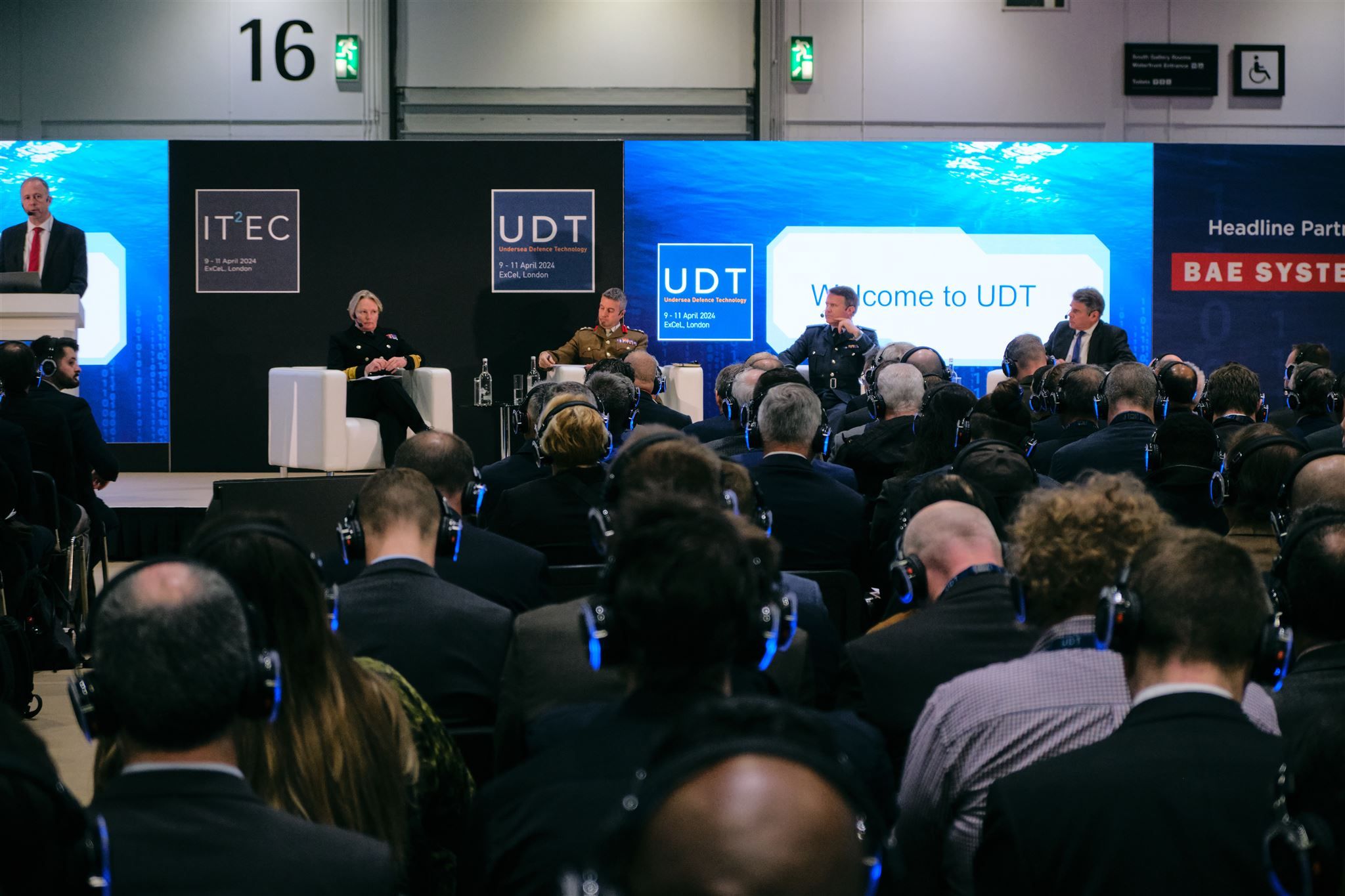
Our technical conference programme remains one of the biggest draws of UDT Europe and continues to expand with new speakers, conference material and more comprehensive content to date.  

With over 100 allied naval professionals, across four theatres, including our keynote theatre, UDT remains Europe's leading event dedicated to undersea defence technology, bringing together the largest gathering of professionals, industry and military experts to discuss the ongoing issues in the subsea industry.  

Our conference speakers offer valuable insight into the technical advancements and operational challenges, supported by our dedicated committee members. 

Interested in exploring speaking opportunities?

conference

UDT Europe 2027 Conference Theme - Undersea defence in the hybrid age

The UDT Europe's 2027 theme focuses on the application of undersea technologies to secure and sustain operational advantage in an increasingly complex, congested and contested battlespace. From persistent seabed presence to integrating autonomous vehicles interoperating with advanced combat systems in contested waters, the event offers a global platform to shape the next phase of undersea defence innovation.

It speaks to the changing nature of maritime fleets as they embrace autonomy and develop hybrid fleets. This revolution will require change across every facet of undersea defence, from doctrine to data and infrastructure to people. It reflects how areas like AI, Quantum, robust communications, autonomy, data science, sensors, and uncrewed systems must converge to redefine how naval forces gain operational advantage, particularly underwater. In an era marked by geopolitical uncertainty, rapid technological evolution, and constrained defence capacity, if not budgets, gaining and sustaining advantage remains essential. UDT 2027 will include the urgent need to accelerate and manage innovation, prioritise investment and seamlessly integrate emerging technologies and thought into effective operational capabilities, including through:

  • "Integration" connects crewed, uncrewed and autonomous systems into a coherent fighting force able to operate across platforms, domains and command structures.
  • "Intelligence" harnesses AI, data, sensing and autonomous decision-support, across seabed to space, to extend reach, sharpen understanding and accelerate decisions in the undersea battlespace.
  • "Impact" turns innovation into operational effect, mobilising academia, industry, government and operators to deliver the right capability at the right time and scale.

Operational effectiveness

Explores the changing balance of factors that Navies must understand to achieve and sustain their advantage in the Undersea Battlespace. That advantage may be in exploiting the undersea environment or preventing an opponent from exploiting it. Aspects include:

  • The impact of a changing strategic environment and complex, environmental extremes in the undersea battlespace
  • Identification and management of evolving threats and the need for rapid response and assurance of target defeat in congested subsea theatres
  • Modern Anti-Submarine and Anti-Surface ISR & Warfare (ASW and ASuW), including survivability, stealth and offensive operations
  • The implications, integration and employment of UUVs in Submarine warfare.
  • Seabed and mine warfare (SBW and MW) including area defence and protection of critical undersea Infrastructure
  • Training and Simulation
  • Evaluation and testing, capability sustainment
  • Multi-vehicle, system and domain integration
Multi-disciplinary solutions

Examines how technologies and knowledge from different domains and disciplines can be integrated to deliver smarter, more resilient undersea defence solutions:

  • Cross-domain innovation (including integration of seabed to space, cyber and air-maritime integration)
  • Climate and oceanographic science with defence implications
  • AI data-driven decision support: big data analytics, automated data classification, anomaly detection and sensor data processing
  • Data science, digital twins, and decision support tools
  • AI assurance, validation and certification for operational use, including explainability, dataset governance, synthetic data and lifecycle management of learning-enabled systems
  • Advanced materials, energy systems, bio-mimetics and sustainable technologies
  • Human performance in undersea operations (including diving, psychology and health)
  • Man–machine teaming, including operator cognitive load and increasing the machine:human ratio
  • Multi-use technologies that could be adapted for defence needs
Platforms and Autonomous vehicles

Focuses on the development, integration and sustainment of crewed platforms, autonomous, uncrewed, and remotely operated vehicles.

  • Programme-level development, build and sustainment of submarines and autonomous and uncrewed vehicles and their systems
  • Improvements in stealthy operation, efficient propulsion, endurance, navigation, human factors and habitability, supportability, modularity and communications arrangements
  • Integration of autonomous, uncrewed and remotely operated vehicles to into the force structure to maximise advantage in the undersea domain, including extending reach, endurance and functionality
  • Energetics for long-duration missions, low-power operations, and efficient, green propulsion
  • Collaborative autonomy: multi-platform coordination and control
  •  Navigation and detection in complex undersea environments
  • Deployable sensors and weapons for autonomous systems.Edge autonomy and on-board computing, including low-power processing, autonomous data reduction and resilient operation under bandwidth and SWaP constraints.
  • Persistent undersea digital ecosystems, including resident systems, docking, seabed nodes and interoperable undersea data infrastructures.
  • Incorporating autonomy into existing fleets, Combat Systems and C2/C3 infrastructure
  • Launch and recovery systems for autonomous vehicle deployment from submarines and surface vessels
  • Biofilm/biofouling control.
Sensors, Weapons and Countermeasures

Address the interdependent warfighting elements needed to deal with emerging threats in dense and dynamic subsea environments. Particular aspects of interest include:

  • Combat management systems including AI enabled decision support: big data analytics, automated data classification, anomaly detection and sensor data processing
  • Collaborative autonomy and seamless incorporation into existing C2 frameworks
  • Cooperative operations: managing mutual interference in distributed undersea operations
  • Developments in undersea sensing and in acoustic and electronic warfare
  • Modularity and adaptability in weapons and payload integration
  • Next generation torpedoes, smart payloads and delivery platforms
  • Advanced defensive systems and countermeasures
  • Developments in Acoustic/Optical Communications
Innovation, Production and Investment
Innovation and Investment

Address the urgent need to co-opt new ideas and technologies and manage bespoke developments to improve and secure supply chains and enable production at scale and time to contribute in the challenging undersea defence arena.

  • Industry-government collaboration and trust-building
  • Rapid capability transition through operational experimentation and T&E
  • Agile research & development and procurement, including practicable management of the Demand Pull and Technology Push paradigm for long-duration submarine and short-duration uncrewed vehicle programmes
  • Accelerated procurement models, including modular upgrades and COTS adaptation, including lifecycle costs, and sustainability
  • Improvements in manufacturing processes to improve quality and rate of production, including enabling improved operational effectiveness through life
  • Providing scale and depth of research, production, support arrangements and infrastructures
  • New solutions and innovations to offset industrial and personnel constraints
  • Budget optimisation and innovation under funding pressures